



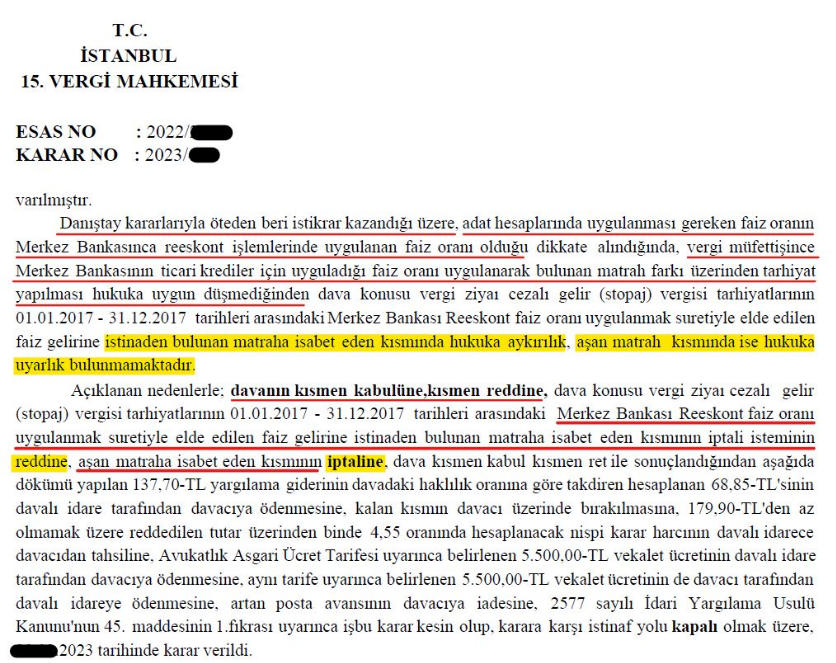
The tax actions we brought against the corporate tax, VAT and income withholding tax assessments made in respect of amounts considered to have been lent to a shareholder interest-free have now concluded.
One of our arguments was that, in calculating the assessment, the weighted average interest rate on commercial loans extended by banks as announced by the Central Bank of the Republic of Türkiye could not be taken as an external comparable, within the scope of decision No. 2021/DK-1/1 of 20/12/2021 taken by the Advisory Commission of the Tax Inspection Board.
The Tax Court rejected our argument as regards the portion to be calculated using the interest rate applied by the Central Bank in rediscount transactions (and even reading our argument that way was itself a mistake) and annulled only the portion of the calculation made above that amount. The use in the decision of the expressions "tax base found on that basis" and "tax base in excess" is striking, since in the present case there is no question of the tax base being divided in whole or in part. Rather than accepting that the tax base on which the assessment was to be made had been calculated incorrectly and annulling the assessment, the court ruled that the administration should determine what tax would have been assessed had the base been calculated correctly, and assess that amount — that is, it upheld a tax base that had never been quantified.
As is known, unlawfulness in administrative acts (such as an assessment) arises from defects in one or more of the elements of competence, form, grounds, subject matter and purpose. The court's acceptance that the calculations in the tax audit report forming the basis of the original assessment were incorrect amounts to accepting a defect in the grounds of the assessment. Unlawfulness in the grounds is a species of unlawfulness that requires the assessment to be annulled.
For a tax court decision to go on, after establishing the unlawfulness of the act, to calculate and rule on the amount of the tax and penalty is an encroachment on the administration's sphere of competence.
In our view, it was wrong for the court, instead of annulling the assessment entirely, to hold that the tax base was incorrect and, by laying down a new method of calculating it, to order tax to be assessed on a base that is not quantified. Decisions of this kind, which create new problems rather than solving them, are unfortunately bound to lead to new actions and new work.
Was this helpful?